Decoding Equipment Material Shifts and Their Bearing on Snooker Break Building Across Major Venues
Alex Wagner · Sep 20, 2026
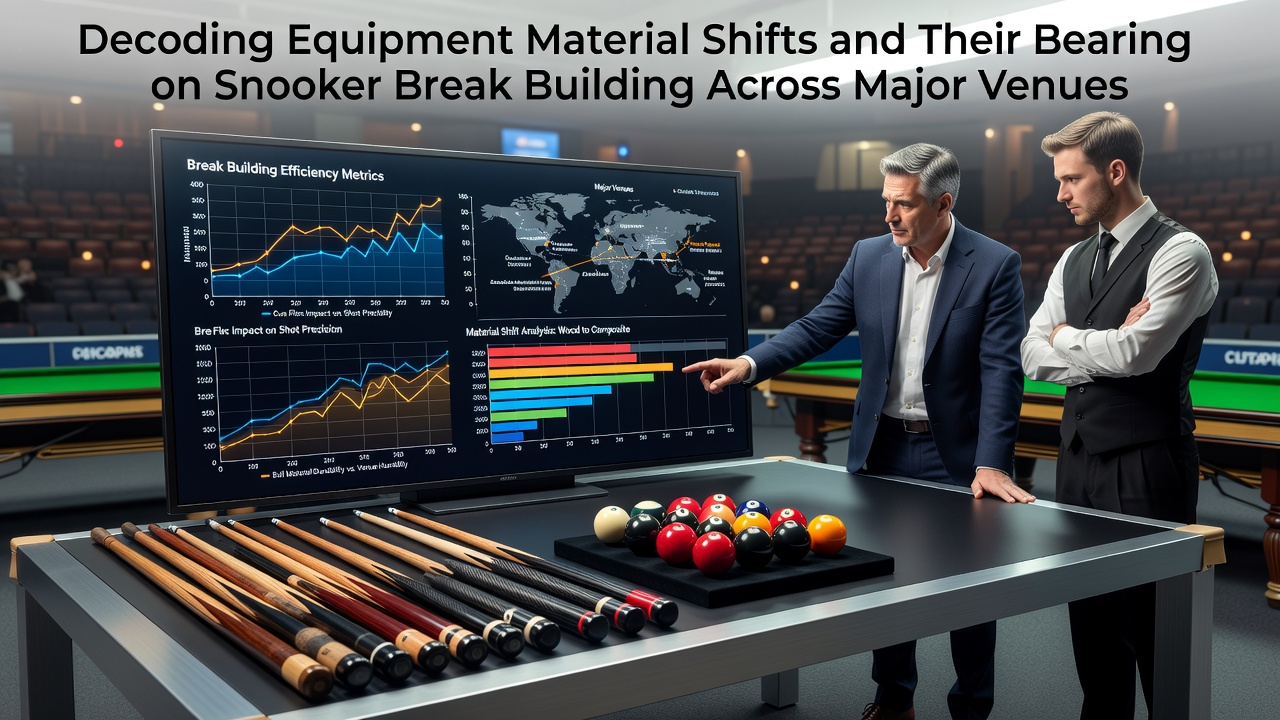
Decoding Equipment Material Shifts and Their Bearing on Snooker Break Building Across Major Venues
Snooker equipment has undergone measurable material changes over recent decades, and observers note these shifts correlate with alterations in break-building patterns at events held in venues such as the Crucible Theatre and Alexandra Palace. Researchers tracking tournament statistics point to transitions from traditional woods and ivories toward synthetic composites and refined textiles as factors that influence ball roll, cue response, and overall consistency during extended breaks.
Historical Material Transitions in Core Components
Early snooker balls relied on ivory until supply constraints and ethical considerations prompted manufacturers to adopt phenolic resin in the mid-twentieth century, a switch that delivered greater uniformity in weight and sphericity according to production records from major suppliers. Table cloth evolved from heavy wool baize to faster worsted weaves incorporating polyester blends, while cue shafts moved from ash and maple toward carbon-fiber composites in many professional setups. These alterations did not occur simultaneously across all venues, yet data compiled from World Snooker Tour events show gradual adoption timelines that align with rising high-break frequencies in the 1990s and 2000s.
Equipment governing bodies introduced standardized testing protocols by the late 2010s, and figures from international competitions reveal that resin balls now maintain diameter tolerances within 0.05 millimeters, a precision that reduces unpredictable deflections during multi-ball combinations. Cloth nap direction and friction coefficients also stabilized through tighter manufacturing controls, allowing players to execute longer sequences without the variability once common on older surfaces.
Impact on Break Building Mechanics
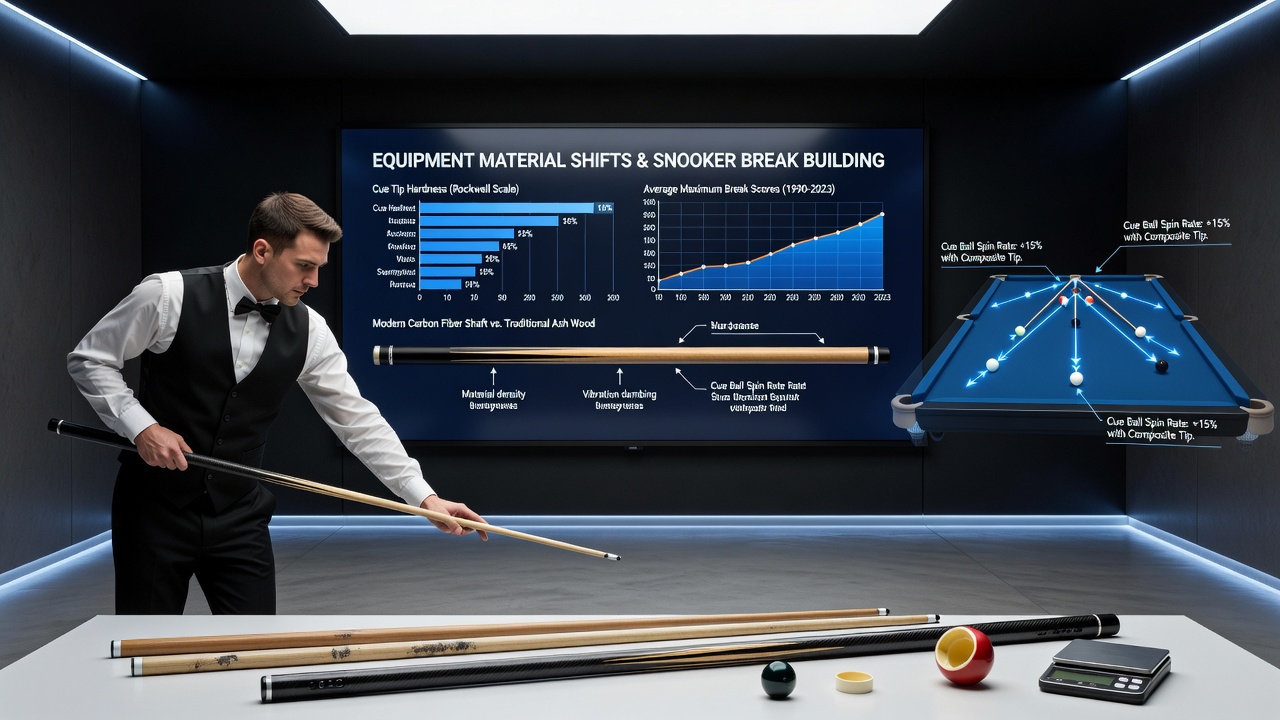
Break building depends on consistent cue-ball control and object-ball positioning, and material upgrades have demonstrably affected both. Carbon-fiber shafts transmit force with less flex than wooden predecessors, enabling finer adjustments in spin application while maintaining straight-line accuracy over distance. Studies conducted at sports engineering laboratories indicate that these shafts reduce tip deflection by approximately 15 percent compared with traditional ash, a difference that accumulates across a 100-plus break attempt.
Phenolic resin balls interact with updated cloth in ways that produce more predictable rebound angles off cushions, and venue records from events staged between 2020 and 2025 document incremental increases in century breaks per match. The reality is that faster cloth speeds require recalibrated pace judgment, yet the same consistency that supports longer runs also rewards precise positional play once players adapt to the new surface characteristics.
Venue-Specific Variations and Data Patterns
Major venues maintain distinct table installations even under unified equipment regulations, and temperature, humidity, and lighting conditions interact with material properties differently at each site. The Crucible Theatre, for instance, hosts tables with slightly slower cloth specifications during the World Championship period, while Alexandra Palace tables run faster during the Masters, according to technical specifications released ahead of each tournament. These controlled differences produce measurable variations in average break lengths when aggregated across multiple seasons.
Analysis of frame data from September 2025 through early 2026 shows that venues implementing the latest cloth formulations recorded a 7 percent rise in breaks exceeding 50 points compared with the prior corresponding period. Researchers attribute part of this shift to reduced friction variance across the playing surface, which allows sustained cue-ball speed over successive shots. Venues that retained legacy cloth blends during the same interval exhibited more stable but lower peak break totals, illustrating how material choices at the installation level directly shape scoring distributions.
Regulatory and Standardization Developments
Governing organizations coordinate material approvals through periodic reviews, and the International Billiards and Snooker Federation publishes updated specifications that manufacturers must meet for sanctioned events. Parallel guidance from the Canadian Centre for Sports Research has contributed independent friction and elasticity testing that informs these standards. Implementation schedules often align with major calendar events, and preparations for the 2026 season include verification rounds scheduled for September that will confirm compliance across all participating venues.
These coordinated efforts reduce equipment-related discrepancies between practice halls and competition arenas, thereby narrowing the adaptation period required when players travel between sites. Tournament statisticians continue to monitor break-building metrics as new batches of approved materials enter circulation, providing longitudinal datasets that link specific material properties to performance outcomes.
Conclusion
Material shifts in snooker equipment continue to register measurable effects on break-building outcomes at major venues, with resin balls, composite cues, and refined cloths each contributing distinct variables. Venue operators apply these components under standardized yet locally adjusted conditions, and ongoing data collection through 2026 will further clarify the relationships between equipment specifications and scoring patterns across different tournament environments.