Shifts in Atmospheric Pressure and Their Unexpected Influence on Ball Trajectory Predictions in Multiple Racket and Ball Sports
Alex Wagner · Nov 1, 2026
Shifts in Atmospheric Pressure and Their Unexpected Influence on Ball Trajectory Predictions in Multiple Racket and Ball Sports
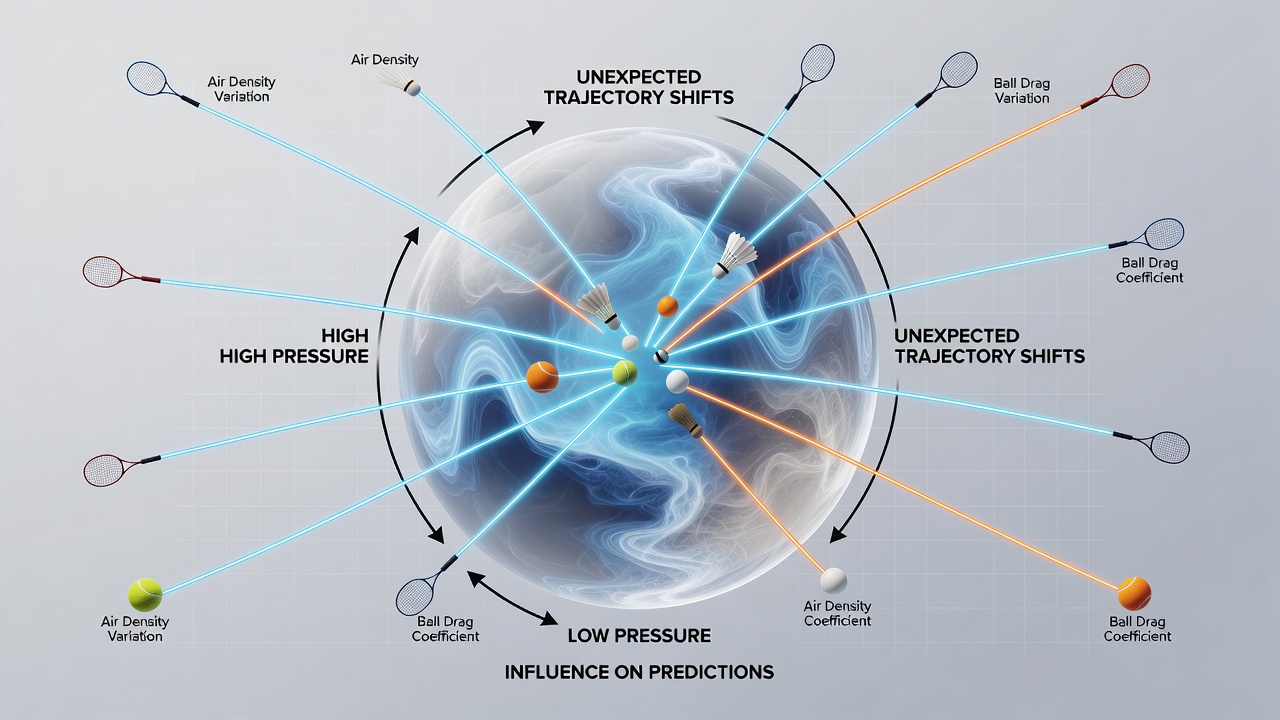
Atmospheric pressure changes alter air density in ways that directly modify drag forces and lift effects on spinning balls, which in turn shifts how far and how curves develop during flight across racket and ball sports. Researchers tracking these variables have measured consistent deviations in predicted paths when barometric readings drop or rise by even modest margins, and those deviations compound during high-speed impacts from rackets or clubs. Data collected from multiple venues show that lower pressure reduces air resistance, allowing balls to carry farther while weakening the Magnus force that creates curve, whereas higher pressure increases drag and sharpens spin-induced bends. Studies examining tennis serve trajectories at different elevations reveal measurable differences once pressure falls below standard sea-level values. In matches played at altitude, the ball slows less rapidly after leaving the racket, which extends the effective court length and alters bounce angles that players must anticipate. Observers note similar patterns in squash and badminton, where the smaller playing enclosures amplify small pressure-driven changes because the shuttle or ball covers shorter distances yet still experiences altered deceleration rates.Physics Behind Pressure-Driven Trajectory Shifts
Air density decreases as atmospheric pressure declines, which lowers the resistive force opposing a ball's forward motion and reduces the pressure differential that generates lift on a spinning sphere. The Magnus effect, created when spin produces uneven airflow, weakens under low-density conditions, so a tennis topspin shot drops less sharply and a baseball curveball breaks with smaller radius. Wind-tunnel experiments conducted by university aerodynamics teams confirm these relationships hold across a range of spin rates and velocities typical in competition. Golf provides another clear case because drive distances respond directly to density changes. When pressure readings drop, carry distance increases by several meters on well-struck shots, while approach shots with backspin lose some stopping power because reduced air density diminishes the lift component. Baseball data gathered across stadiums at varying elevations show outfielders adjusting positioning because fly balls travel farther on low-pressure days, and pitchers find their breaking pitches flatten when density falls.Evidence from Multiple Sports and Venues
Longitudinal records from professional tennis circuits indicate that serve speeds remain constant yet landing positions shift outward when venues report lower barometric pressure, forcing players to adjust target locations inside teh service box. Similar adjustments appear in badminton rallies, where the shuttlecock decelerates more slowly and crosses the net with flatter trajectories under reduced pressure. Researchers compiling these observations across seasons have isolated pressure as an independent variable by controlling for temperature and humidity in their models. Baseball stadiums equipped with weather sensors provide granular datasets that link daily pressure fluctuations to hit distances and pitch movement. One analysis covering several years found that a 10-millibar drop correlates with measurable increases in home-run rates at certain parks, while curveball usage declines because the expected break fails to materialize. Racket sports played indoors still register effects when HVAC systems allow external pressure changes to influence court conditions, though the magnitude stays smaller than outdoor variations.